
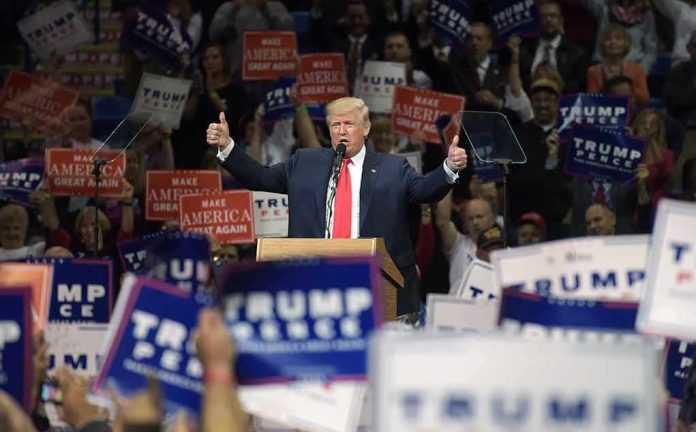
Trump told South Carolinians that if they sit out now, they risk losing everything he says they’ve won.
Story Snapshot
- Trump framed the election as keep the gains or watch them vanish
- He urged South Carolina voters to turn out and defend recent progress
- The message fit his long-used conflict-and-consequence style
- Prepared remarks anchored the warning in concrete stakes and timing
Trump’s South Carolina message: defend gains or lose them
President Trump used a stop in Greenville, South Carolina to deliver a blunt warning. He said opponents would undo recent gains if his supporters do not show up. He tied the warning to early voting and the state’s calendar. He said he is running to “save the country” and to restore national strength and pride, and he told voters he was “not going anywhere” after the primary. The prepared text set a simple choice: continue the agenda or risk reversal.
The language drew a straight line from turnout to policy outcomes. He cast the election as a guardrail against slippage. He did not drown it in jargon or numbers. He pressed a basic point: wins do not defend themselves; people do. That is an appeal that hits fast with busy voters. It also sets a test for his base. If they believe the gains are real, he argued, then they must protect them at the polls.
Why this warning lands in South Carolina
South Carolina is a loyal stop for Trump, and he treats it like a launch pad. He often reminds crowds he has carried the state handily in past runs, both in primaries and in general contests. That history helps him sell urgency without sounding uncertain. He can praise the state’s record and still call for more. That mix keeps loyalists energized and makes the warning feel like a shared duty, not a lecture.
The Greenville script also used timing as leverage. Early voting was underway, so the ask was immediate. Campaigns know a tight clock sharpens attention. Trump’s team paired the warning with concrete action: vote now, bring two friends, keep the train moving. The short, direct phrases fit phone-sized attention spans. The cadence was familiar to his audiences and easy to repeat in church parking lots, break rooms, and tailgates.
The rhetoric choice: conflict and consequence
Trump’s frame fits a pattern researchers have mapped for years. Studies of his campaign speech show a higher share of conflict, blame, and economic consequence framing than many rivals. That style highlights losses that could come if voters pick the other side. It also turns policy into a simple, kitchen-table stake: jobs, prices, safety, borders, and pride. Voters do not need a white paper to get the point of “do not lose what we built”.
That does not make the warning empty. It turns a list of achievements into a turnout tool. It also pressures lawmakers down ballot. If supporters accept that gains are fragile, they are more likely to vote straight ticket to guard them. That aligns with conservative common sense: protect what works, do not gamble with it. Many on the right see this as prudence, not fear. They prefer a hard-edged warning over soft talk that blurs real trade-offs.
What “lose everything” signals to policy voters
Voters who track policy will hear subtext in “lose everything.” It points to taxes, regulation, courts, energy, border enforcement, and policing. Trump often links those to daily costs and security. When he says “we built this,” he means rules and judges as much as ribbon cuttings. The Greenville text placed that bundle under one roof and then guarded the door with turnout. The logic is simple: if policies came by elections, they can leave the same way.
The warning also sets a marker for accountability. If gains hold, Trump can credit turnout and message discipline. If they slip, he can say the base stayed home. That is classic mobilization talk. It shifts the battlefield from polls to people. It also matches how many conservative voters see civic duty. They believe freedom fades when citizens go quiet. Trump’s line gives that belief a date, a place, and a reason to act now.
Sources:
rev.com, democrats.senate.gov, whitehouse.gov