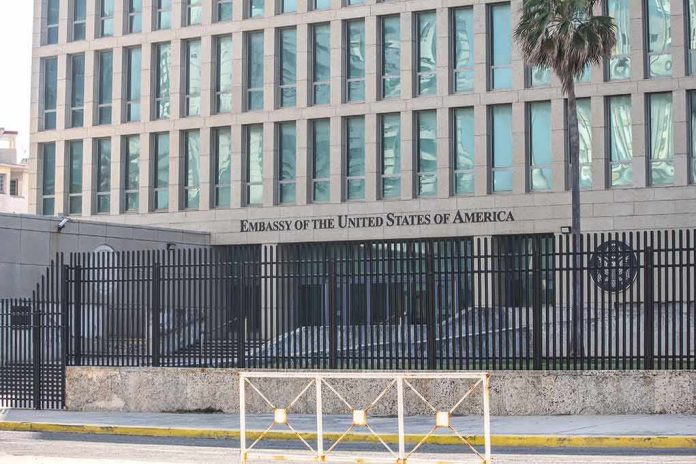
Washington pulled non-emergency U.S. diplomats and families from Saudi Arabia after Houthi strikes hit civilian airports and energy sites, and the missions stayed open while the risk rose.
Story Snapshot
- The State Department ordered some staff and families to leave Saudi posts.
- Officials linked the move to Houthi attacks on airports and key infrastructure.
- Embassy and consulates stayed open with essential services still operating.
- The United Nations condemned the deadly strikes as escalatory and reckless.
What Washington Ordered And Why It Matters
The State Department directed non-emergency U.S. government employees and family members to depart Saudi Arabia. The order applied to the embassy in Riyadh and the consulates in Jeddah and Dhahran. The department tied the step to attacks by the Iran-aligned Houthi movement on civilian airports and critical infrastructure inside the kingdom. Missions remained open, and core consular work continued. This reads as a risk trim, not a rupture, but it shows the threat line was crossed for dependents.
The decision followed a surge of strikes that disrupted air travel and hit fuel sites. The State Department’s alert cited growing hostilities that caused civilian deaths and major travel delays. A practical note is clear here: missiles and drones do not check passports. When airports and energy hubs take fire, diplomats and their families face the same shrapnel risk as everyone else. Pulling non-essential people lowers exposure while protecting key services.
What The United Nations Said About The Attacks
The United Nations Security Council issued a presidential statement condemning Houthi strikes that killed civilians and damaged aviation and energy infrastructure. Council members described the attacks as escalatory and reckless, pointing to strikes on King Khalid International Airport on October 10 and 11 that reportedly left 13 dead and more than 300 wounded. The Council’s language matters. It signals unified concern about civilian targets and adds weight to steps allies take to reduce risk.
The Council also warned that continued attacks on airports and oil facilities raise the odds of wider fallout across the region. When air hubs stumble, evacuation, aid flights, and business travel all suffer. When energy sites burn, the knock-on hits prices, shipping, and supply chains. Against that backdrop, a limited drawdown looks like common sense. It limits the number of potential casualties without closing America’s door in a vital partner nation.
How The Ordered Departure Differs From An Evacuation
An ordered departure is a calibrated tool. It reduces headcount without declaring an emergency evacuation or shuttering an embassy. In Saudi Arabia, essential personnel stayed on duty, and public-facing services continued. That split tells you Washington judged that core diplomacy could proceed even as the threat to families and non-critical roles grew too high. It also shows respect for host-nation ties while keeping faith with the duty to protect U.S. personnel.
This approach aligns with sound, conservative stewardship: safeguard people, sustain the mission, and avoid performative panic. Pulling families from a known danger zone is not mission creep; it is prudence. Keeping the flag up in Riyadh while trimming risk also preserves leverage. America still talks, vets visas, and coordinates security. But it does not gamble with dependents when missiles are landing near runways.
The On-The-Ground Reality Driving The Risk Call
Recent strikes hit civilian airports and Saudi Aramco facilities, according to contemporaneous reporting and United Nations accounts. The United Nations Security Council memorialized the October airport attacks with specific casualty figures, and its statement labeled the pattern as ongoing and escalatory. That record helps explain the State Department’s timing. When civilian hubs face repeat fire, risk climbs quickly. Travel snarls, tarmac repairs, and debris hazards all raise the danger to anyone moving in or out.
The State Department also stressed the geographic limit of its action. The order applied to Saudi Arabia only, even as posts elsewhere in the Gulf adjusted staffing for flexibility. That detail signals a targeted response. It aimed to balance safety with stability, not to telegraph a wider break. One caveat remains typical of such moves: officials did not publish the internal threat matrix that triggered the order, which is standard practice during active security crises.
Sources:
military.com, press.un.org, usnews.com, apnews.com