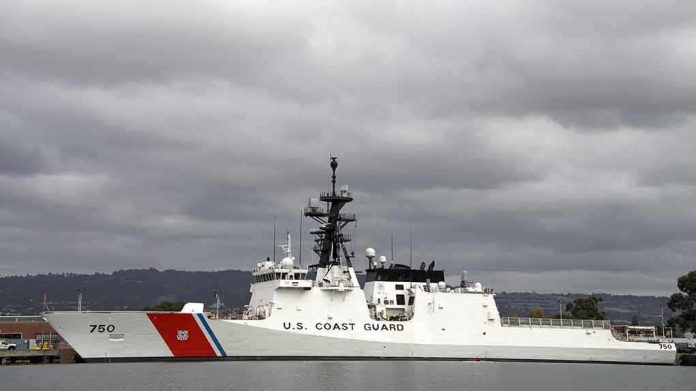
A 45-foot wooden boat packed with 240 people and taking on water was spotted drifting south of the Turks and Caicos Islands — and what happened next reveals exactly how America’s maritime border enforcement actually works when the cameras are rolling.
Story Snapshot
- The U.S. Coast Guard, Customs and Border Protection (CBP) Air and Marine Operations, and Turks and Caicos authorities jointly intercepted an overcrowded vessel carrying 240 Haitian migrants on May 31, 2026.
- The boat was overloaded and actively taking on water when surveillance assets located it south of the Turks and Caicos Islands.
- Turks and Caicos Regiment executed a tactical interception and immediate stabilization of the vessel before transferring all persons to local Border Force custody.
- The operation is part of a documented, recurring pattern of multi-agency maritime interdictions in the Caribbean corridor — this stretch of ocean is far busier with migration traffic than most Americans realize.
How a Sinking Boat Triggered a Three-Nation Response
Customs and Border Protection Air Interdiction Agents spotted the vessel first. That aerial detection triggered a coordinated response that pulled in the U.S. Coast Guard, CBP Air and Marine Operations, and both the Royal Turks and Caicos Islands Police Force and the Turks and Caicos Islands Regiment. The Royal Turks and Caicos Islands Police confirmed the vessel was tracked continuously before the Coast Guard executed the interception. [2] That sequencing matters — this was not a chance encounter. It was a deliberate, intelligence-driven operation.
Once alongside, Turks and Caicos Regiment personnel performed what official records describe as a “tactical interception” and the “immediate stabilization of the vessel.” [5] That phrase is doing real work. A 45-foot wooden boat carrying 240 people is not a vessel — it is a floating catastrophe waiting to complete itself. The stabilization step almost certainly prevented mass casualties before anyone could be transferred to safety. The vessel was then towed to South Dock Marina, and all persons aboard were handed to the Turks and Caicos Islands Border Force for processing. [2]
The Numbers Tell the Story the Headlines Miss
Two hundred and forty people on a 45-foot wooden hull works out to roughly one person per 2.5 inches of boat length. For comparison, a standard charter fishing vessel of that size is certified for perhaps 12 to 15 passengers under U.S. Coast Guard safety regulations. The CBS12 reporting describes the boat as “overloaded” and “taking on water,” [1] which at that passenger density is not a dramatic editorial choice — it is a physics observation. The Defense Visual Information Distribution Service (DVIDS) video from the Coast Guard documents the operation in real time, leaving little ambiguity about the scale of what responders encountered. [6]
This was not an isolated event. The Coast Guard Cutter William Trump intercepted a separate migrant vessel 60 miles south of Turks and Caicos in September 2024, with 182 migrants subsequently repatriated to Haiti. [4] The Turks and Caicos Regiment has documented multiple coordinated maritime operations in the same corridor, including a separate interception involving 143 irregular migrants. [5] The pattern is consistent and accelerating, which means the infrastructure and protocols for these operations are being stress-tested repeatedly in a relatively small geographic window.
What the Official Record Does and Does Not Prove
The documented facts support a clear enforcement and rescue narrative: a dangerously overloaded vessel was detected, tracked, intercepted by coordinated multi-agency assets, stabilized, and its passengers transferred to lawful custody. [6] [3] What the public record does not yet establish is the passengers’ declared destination or the specific legal authority cited for the interception. Those gaps are normal at this stage — incident reports, cutter logs, and after-action files typically lag public reporting by weeks or months. The absence of that documentation does not weaken the operational facts; it simply means the legal architecture of the interception has not yet been publicly tested.
US Coast Guard intercepts vessel with 240 migrants near Turks and Caicos Islands https://t.co/zwUaaSjEfL
— MixVale (@Mixvale) June 5, 2026
Critics will argue the migrants may not have been heading to the United States, and geographic proximity to Turks and Caicos alone does not prove unlawful U.S. entry intent. That is a fair evidentiary point. It is also largely beside the point of what actually happened on the water. A vessel in that condition, carrying that many people, in those seas, represented an imminent mass-casualty event regardless of its declared destination. The agencies that responded did what border enforcement and maritime rescue doctrine both require: they stopped the boat before the ocean did. That is not overreach — that is the job, executed correctly.
Sources:
[1] Web – Coast Guard Stops 240 Illegal Immigrants on Overcrowded Vessel
[2] Web – Overcrowded boat carrying 240 Haitian migrants interdicted near …
[3] Web – Illegal vessel intercepted – Royal Turks and Caicos Island Police
[4] Web – Coast Guard helps intercept overloaded vessel carrying 240 migrants
[5] Web – Coast Guard repatriates 182 migrants to Haiti
[6] Web – TURKS AND CAICOS ISLANDS REGIMENT INTERCEPTS VESSEL …