One man walking into a Bakersfield office tower claiming to wear a bomb forced an entire downtown to confront how fragile normal life really is.
Story Snapshot
- A reported bomb threat and hostage situation shut down downtown Bakersfield around a Chase Bank building.
- Police and Federal Bureau of Investigation (FBI) negotiators worked for hours as the suspect held multiple people inside.[2][3]
- Hostages were gradually released; the suspect was ultimately killed and all captives survived.[1]
- The incident highlights how early “bomb strapped to his chest” headlines can outrun confirmed facts and feed public fear.[3][4]
How an Ordinary Tuesday Turned Into a Downtown Siege
Police officers in Bakersfield were first called to the Chase Bank building at 17th Street and Chester Avenue after a reported bomb threat, the kind of phrase that instantly changes every decision first responders make.[1] Dispatchers relayed that a man had entered the building and threatened to detonate explosives, triggering evacuations and street closures as officers moved to contain the scene.[2][3] What may have begun as one person’s grievance or breakdown quickly became an urban security crisis.[2]
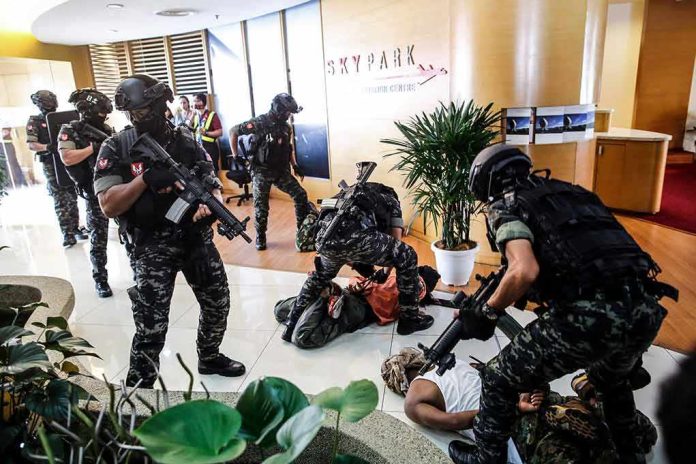
Authorities soon treated the situation as a full-fledged hostage standoff, not just a suspicious-person call.[2][3] Police said the man had “several community members” with him inside, language that usually reflects more than one potential hostage.[2] Media briefings and live coverage repeated that at least one hostage was being held and that the suspect allegedly had a bomb strapped to his body.[3] For people watching from home, the narrative crystallized fast: bomb, hostages, downtown Bakersfield under siege.[3][4]
Inside the Building: Hostages, Threats, and Negotiation
The suspect barricaded himself on a floor associated with the Chase Bank complex, but company representatives later stressed the confrontation unfolded on a neighboring floor, not inside the bank branch that most customers recognize.[1] That distinction matters for liability and public confidence, but to those stuck inside, the building address was all that counted. Police reported that at least one hostage was under the suspect’s control as negotiators engaged him for hours.[2][3]
Over police radio, accounts circulated of a man ordering everyone to get down and reportedly attempting to rig some form of tripwire to a hostage’s legs, a terrifying detail whether or not a live explosive existed.[3] This is where common sense and conservative instincts align with law enforcement doctrine: when someone claims to have a bomb and uses people as shields, authorities must assume the worst. No responsible officer waits for a lab report before treating the threat as real. Lives come first; perfect certainty comes later.[2][3]
Lockdowns, Leverage, and the Fight Over Public Perception
City leaders responded by locking down multiple government buildings, including city hall and police headquarters, turning a few square blocks into a hardened zone.[1] Businesses in the area saw streets closed, customers pushed away, and workers stuck outside police tape with no timeline for returning.[2] From a civic standpoint, one man’s threat effectively commandeered public resources, disrupted commerce, and exposed how easily government must bend when safety is on the line.
Media coverage leaned into the most dramatic elements: “bomb threat,” “hostages,” “bomb strapped to his body,” all technically grounded in what officers believed they were facing.[2][3] Yet none of the early reporting cited a bomb squad confirmation of a live device or forensic details about explosives.[1][3][4] That gap between operational reality (treat it as real) and evidentiary reality (prove it was real) is exactly where modern distrust festers. Many Americans now ask, after the fact, whether the crisis matched the headline.
How the Standoff Ended and What We Still Do Not Know
After nearly fifteen hours of tension, sources told national media that the suspect was dead and all hostages were safe.[1][4] ABC-affiliated reporting described a suspect killed after the prolonged standoff, with everyone he had held emerging alive.[1] That outcome reflects a tradeoff American conservatives often support: prioritize innocent life, accept the risk that the perpetrator may not walk away. The alternative—gambling with hostages to preserve the suspect—rarely squares with public expectations of justice.
A hostage situation in downtown Bakersfield, California, ended after FBI personnel fatally shot a suspect who had barricaded himself inside a building housing a Chase Bank branch and a school district office, according to authorities.
The standoff began on June 2 following… pic.twitter.com/c3ocH7CuSD
— APT News (@APT__News) June 3, 2026
What remains unresolved in the public record is whether the suspect truly possessed a working bomb.[1][3][4] Coverage describes an “alleged bomb,” “bomb threat,” and reports that he may have had explosives strapped to his body, but offers no detailed post-incident confirmation of a device.[3][4] That ambiguity does not mean the threat was harmless; it does mean the story most people will remember—man with a bomb strapped to his chest—rests more on his claims and the necessary police response than on disclosed forensic proof.
Sources:
[1] Web – DEVELOPING: Man with Bomb Strapped to His Chest Takes at Least One …
[2] Web – Police negotiate in hostage situation at Chase Bank amid bomb threat …
[3] Web – Possible hostage situation underway at Southern California bank
[4] Web – Hostage situation underway at Chase Bank in Bakersfield …