Kerry Sheron’s death after the Escondido assault is a reminder that a house can become a political symbol long before investigators can prove a motive.
Quick Take
- Sheron was widely known locally for prominent Trump displays and American flags outside his Escondido home.
- Reporters said he died after an attack outside that house, but police had not publicly released a motive in the cited coverage.
- His wife said the couple had received threats tied to their political views, which fueled suspicion but did not prove intent.
- Friends and family quoted in reporting pushed back on the idea that the assault was politically motivated.
The House That Drew a Crowd Before the Attack
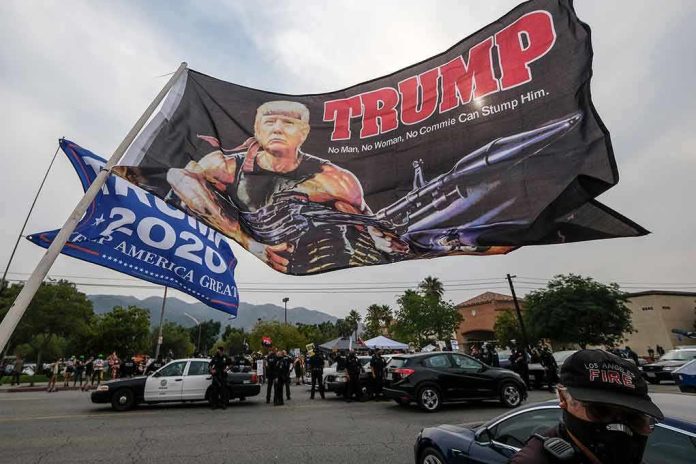
In Escondido, Kerry Sheron’s home was not just a residence; it was a public statement. Local reports described it as the “Trump House,” a place marked by large American flags and Trump-themed displays that made Sheron instantly recognizable to neighbors and passersby.[2][3] That visibility mattered because it turned a private attack into a public question: was this a random beating, or an assault on the person who lived behind the symbolism?
The first fact that matters is narrower than the politics wrapped around it. Sheron died after being attacked outside his home, and court reporting noted that the suspect pleaded not guilty. But the record cited here does not establish why the attack happened. That distinction is critical, because public symbols create strong assumptions, yet assumptions are not evidence.
What the Reporting Supports, and What It Does Not
The strongest support for a political-reading of the case comes from Sheron’s obvious pro-Trump identity and the claim by his wife that the family had previously received threats over their political views.[1][3] That is enough to explain why many readers immediately saw the assault through a political lens. It is not enough to prove that the attacker acted for political reasons, because the cited reporting stops short of a confirmed motive.
ABC 10’s reporting said police had not released a motive, and that omission is not a minor detail. It is the dividing line between public inference and verified fact. When a case begins with a highly visible political target, people often fill the silence with theory. That instinct is understandable, but the evidentiary standard remains the same: what can be shown, not what feels most plausible.
The Counterpoint That Prevents Overreach
The counterargument in the available coverage is simple and important: some relatives and friends did not believe politics drove the attack.[3] Reporting also described the suspect as a transient with mental health issues, which offered an alternative explanation for the violence without proving one.[3] Those details do not exonerate the suspect; they do, however, show why the case should not be flattened into a slogan before the facts are finished.
Owner of Escondido ‘Trump House’ dies from injuries suffered in assault https://t.co/jmSrlqOlhI
I used to honk everutime i drove past his house if he was outside he always waved to Trump fans that would honk. I am so sad that tjis happened!
— Alicia C.C. (@ChicasSarcasm) May 26, 2026
That caution lines up with a conservative instinct that many readers share: do not confuse symbolism with proof. A Trump sign, a flag, or a house plastered with partisan imagery can attract hostility, but hostility is not the same thing as a demonstrated political plot. Sheron’s death is tragic either way, yet the honest reading of the record is that motive remains unresolved in the cited reporting.[1]
Why This Story Kept Spreading
Cases like this travel fast because they contain all the ingredients of modern outrage: a veteran, a politically charged home, a violent attack, and a family left searching for meaning. That combination encourages people to choose a side before investigators finish their work. The result is not clarity but narrative warfare, with each camp emphasizing the facts that fit its instinct and discounting the facts that do not.
The deeper lesson is less dramatic and more unsettling. When a home becomes a billboard for a movement, the owner also becomes a public figure in the eyes of strangers. That can bring admiration, attention, and, in the worst moments, risk. But the final judgment still has to rest on evidence. In this case, the evidence in the cited reporting confirms the victim’s political visibility and the attack itself; it does not yet confirm a political motive.[1][2]
Sources:
[1] Web – Suspect in ‘Trump House’ owner attack is mentally ill Navy vet …
[2] YouTube – Escondido ‘Trump house’ owner dies after brutal attack
[3] YouTube – Escondido man hospitalized after attack outside his Trump-themed …