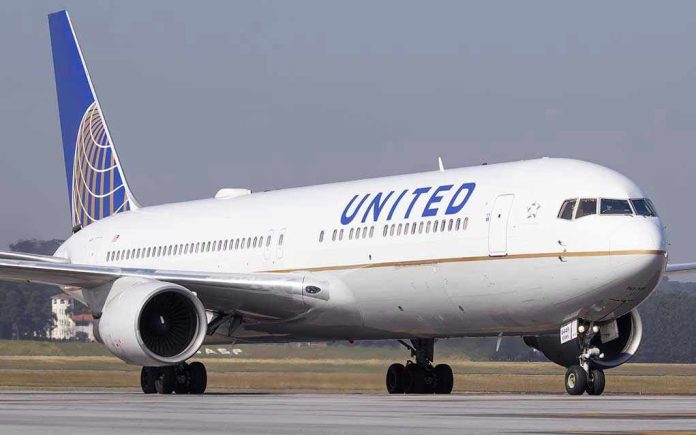
The most unnerving part of United Flight 1551 was not the altitude, the darkness, or the turbulence, but a single passenger who allegedly walked toward Door 2L and turned a routine trip into a sudden emergency.
Story Snapshot
- United Flight 1551 from Newark to Guatemala City diverted to Washington Dulles after a serious onboard disturbance.[1]
- The captain reported that a passenger tried to manipulate a cabin door at 36,000 feet and assaulted another traveler.[1][3]
- Federal authorities met the aircraft on landing and took the suspect into custody, though public charging documents have not yet surfaced.[1]
- The case highlights rising unruly-passenger incidents and why crews now default to “land now, sort it out later.”[1]
How A Night Flight Turned Into An Emergency Diversion
United Airlines Flight 1551 pushed back from Newark Liberty International Airport as a straightforward evening run to Guatemala City, carrying roughly 145 passengers and seven crew members.[3] Somewhere over the East Coast, that predictability vanished. The crew called air traffic control and requested an immediate diversion, reporting “Door 2L at 36,000 feet, and then assaulted a fellow passenger,” a concise summary that tells controllers everything: credible threat, physical violence, and a door involved.[1][3] The destination changed to Washington Dulles.
The Federal Aviation Administration later confirmed the bare bones: the aircraft departed Newark and landed safely at Dulles around 8:30 p.m. after the crew reported a passenger disturbance.[1] No injuries beyond the alleged assault victim were reported. The airplane itself was unharmed, fuel was dumped in the form of ticket value and schedule integrity, and everyone onboard spent the night in Washington instead of waking up in Guatemala. The original flight was canceled, and United rebooked people on a replacement the next morning.[1][3]
What “Tried To Open The Door” Really Means At 36,000 Feet
Every frequent flyer who saw the headline probably asked the same thing: “Could that door actually open?” The short answer is no, not at cruising altitude. Modern jet doors plug into the fuselage and cabin pressurization holds them shut with a force no single human can overcome at 36,000 feet. Aviation analysts stress that while the attempt is physically futile, it is still criminal, disruptive, and frightening to everyone nearby.[3] Yanking at a door handle mid-flight is the airborne equivalent of waving a gun-shaped object in a crowded theater.
Passengers near the door reportedly saw the man move toward Door 2L, with the captain’s report suggesting some form of manipulation before cabin crew and bystanders intervened.[1][3] The allegation does not mean the door came close to opening; it means a passenger moved from being annoying to posing a perceived safety threat. In a metal tube miles above the ground, perception matters. When a captain hears “passenger at the door” plus “assault,” the safety calculus is over; diversion becomes a duty, not a debate.[1]
Assault, Custody, And The Silence After The Headlines
Reports describe an alleged attack on another traveler near the door, though details about injuries remain thin.[1] The term “assault” in this context can cover a wide range of conduct, from shoving and grabbing to punching, but federal law treats interference with the crew and violence aboard an aircraft as serious offenses. Federal law enforcement officers met Flight 1551 at Dulles and took the suspect into custody, but public reporting does not yet show which agency booked him or what statute they cited.[1]
No complaint, indictment, or affidavit had surfaced by the afternoon after the incident, at least in the public record reflected in early coverage.[1] That gap does not prove the allegation false; it highlights how the federal process moves more slowly than social outrage. Conservative common sense should hold two truths at once: the captain and crew deserve a strong presumption of acting properly to keep people safe, and the accused still deserves due process before the government brands him a criminal for life. Both safety and fairness matter if we want trust in the system.
From Rare Headline To Recurring Pattern In The Skies
This diversion did not happen in a vacuum. Federal Aviation Administration data shows unruly-passenger reports exploded during and after the pandemic, peaking in 2021 and remaining well above pre-pandemic norms through 2024.[1] Most cases never make national news, but the trend forces airlines into a new operating mentality: one aggressive passenger can cost hundreds of people their time, thousands of dollars in fuel and lodging, and precious schedule resilience. “One incident is too many” has become less slogan and more grim daily reality for flight crews.[1]
United Airlines Flight 1551 made an emergency landing after a passenger tried to open a cabin door and assaulted another passenger mid-flight. The "plug door" design prevented depressurization. FBI detained the suspect at Washington Dulles. #UnitedAirlines #Aviation #WashingtonDC…
— AirPro News (@AirProNews) May 22, 2026
Crews also face a cultural shift: alcohol, anxiety, entitlement, and mental-health struggles now board every flight, just like carry-ons. When the captain of Flight 1551 chose to divert, he weighed more than just the door attempt. He weighed the risk that letting an out-of-control passenger remain onboard for hours might end in blood, or force other passengers to become amateur security teams. Landing early put the inconvenience squarely on the airline’s shoulders instead of gambling with the lives of 150 souls and the reputations of every regulator who would be second-guessed afterward.[1][3]
Why This Case Should Shape How We Fly And How We Judge
Episodes like Flight 1551 offer a simple lesson to every traveler: the cabin is not your living room. Touching a door or laying hands on another passenger is not a customer-service issue; it is a federal problem. At the same time, the lack of immediate public charging documents should remind us to keep some humility about what we do not yet know. Americans can support tough consequences for genuine threats while still insisting that law enforcement show its work before the media verdict becomes permanent.[1]
Sources:
[1] Web – United passenger tries to open door mid-flight, plane …
[3] Web – United Airlines Flight Diverts After Passenger Tries To …