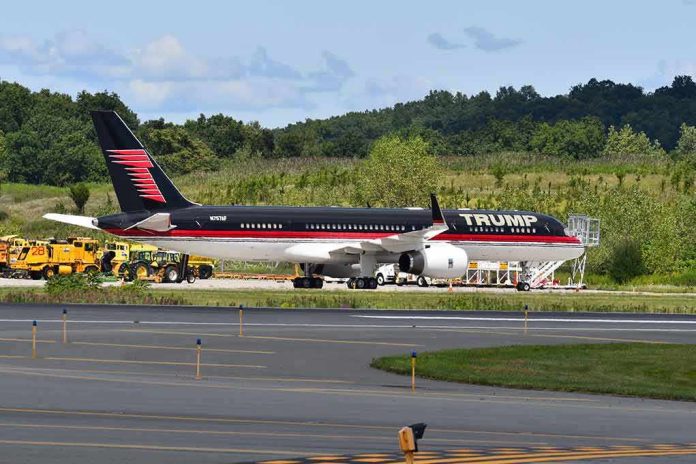
Florida just turned its busiest Palm Beach runway into a monument with Trump’s name stamped on every mile of concrete.
Story Snapshot
- State law now forces Palm Beach’s main airport to carry the name President Donald J. Trump International Airport
- Local county commissioners agreed only by a razor-thin 4–3 vote after bitter public debate
- The Trump Organization gains control over branding while taxpayers face millions in rebranding costs
- Travel codes and signs are changing in stages, creating both political theater and real-world confusion
How Florida Handed Trump An Airport By Law
Governor Ron DeSantis did not wait for a big ceremony or long debate in Tallahassee. He quietly signed House Bill 919 on March 30, 2026, a bill that yanks airport naming power away from local governments and centralizes it at the state level. That single signature ordered Palm Beach International Airport to be renamed President Donald J. Trump International Airport, turning a local travel hub into a statewide political prize tied directly to Trump.
The law does more than swap letters on a sign. It amends Florida statutes so the state, not Palm Beach County, sets the names of major commercial airports. That move sidesteps local dispute and locks in Trump’s name by statute, much the way John F. Kennedy or Ronald Reagan ended up on airports, but with extra muscle from Tallahassee. Supporters frame it as honoring the first Florida resident elected president; critics see it as top-down power, not bottom-up respect.
The County’s Razor-Thin Deal With The Trump Organization
State law alone could have changed the airport’s name on paper, but it could not give Trump’s business legal control over the brand. For that, Palm Beach County commissioners had to sign off. After fiery public comments and hours of argument, they voted 4–3 to approve a licensing agreement with the Trump Organization. That narrow vote showed just how divided the local government is, even as the state pressed forward with the renaming.
The licensing deal gives the Trump Organization control over how the name, image, and likeness are used in airport branding, merchandise, and marketing. According to local reporting, the agreement includes wide oversight by Trump’s company over logos and promotional materials tied to the airport. From a conservative, rule-of-law view, the deal follows proper process: elected commissioners voted, a contract was signed, and private property rights in the Trump brand are respected. The real question is whether the perks and control are balanced by clear benefit to taxpayers.
Codes, Signs, And The Slow March To ‘Officially Operational’
Airport names are political; airport codes are practical. The airport’s own announcement and name-change frequently asked questions explain that the Federal Aviation Administration handles location identifiers and the International Air Transport Association handles booking codes. The plan has the Federal Aviation Administration changing the location code from PBI to DJT and the International Civil Aviation Organization code from KPBI to KDJT, tied to July 9, 2026. Airline tickets and travel sites will follow later when the International Air Transport Association shifts its public-facing PBI code to DJT.
On the ground, Palm Beach County began installing new signs that read President Donald J. Trump International Airport along key roads, including Southern Boulevard, now President Donald J. Trump Boulevard. News crews have filmed travelers pausing at the updated roadside signs, some excited, some confused. There is a gap where the physical world says Trump, but many apps and printed materials still say PBI. That overlap feeds both media drama and real-world navigation mistakes, at least until the codes fully sync with the new name.
Who Pays, Who Benefits, And Who Is Mad About It
Renaming a major airport is not cheap. Estimates from state and local reports place rebranding costs around $5.5 million, covering new signage, uniforms, maps, and marketing. The Florida budget sets aside about $2.75 million to help with the change, leaving the county to cover the rest. Democrats and some local residents argue this is a waste of public money, especially when airports face other needs like safety upgrades and runway work. From a fiscal conservative lens, those critics raise a fair question about priorities.
Palm Beach International Airport in Florida has officially been renamed President Donald J. Trump International Airport.
The change took effect on July 9, 2026, after a state law passed earlier this year. The airport code will change from PBI to DJT on August 18.
Trump frequently…— Port Watch (@PortWatchman) July 9, 2026
The Trump Organization pushed for trademark protection linked to any airport using Trump’s name, saying it was needed to shield the brand as Florida advanced the bill. Supporters argue that a strong trademark deal keeps trial lawyers away and adds polish to a major gateway city. Opponents see a pattern: public institutions carry Trump’s name while his business gains leverage over how that name is used. Lawsuits already filed in local courts challenge whether the state can override county ownership and control of the airport.
How This Fits The Bigger Map Of Presidential Airports
Across the country, naming airports after presidents is common. At least eleven United States presidents have airports that carry their names, from John F. Kennedy to Ronald Reagan. In most cases, local authorities worked with Congress or state leaders to honor a former president with broad bipartisan support. Palm Beach stands out because the Florida legislature wrote the honor into state law and stripped local naming authority at the same time. That structural twist is what keeps lawsuits and op-eds flowing.
Conservative-minded observers will see two overlapping stories here. First, a red-state government uses clear legal authority to honor a president popular with its voters, near his home base at Mar-a-Lago. Second, the move sparks a loud test of federalism inside the state itself, with local officials fighting the state over who controls the name on a county-owned airport. The runway is open, planes land, and life goes on, but each departure now carries a question baked into the name: who really owns the symbols that define public space?
Sources:
youtube.com, wlrn.org, pbia.org, news4jax.com, palmbeachpost.com, cbs12.com, facebook.com, pbs.org