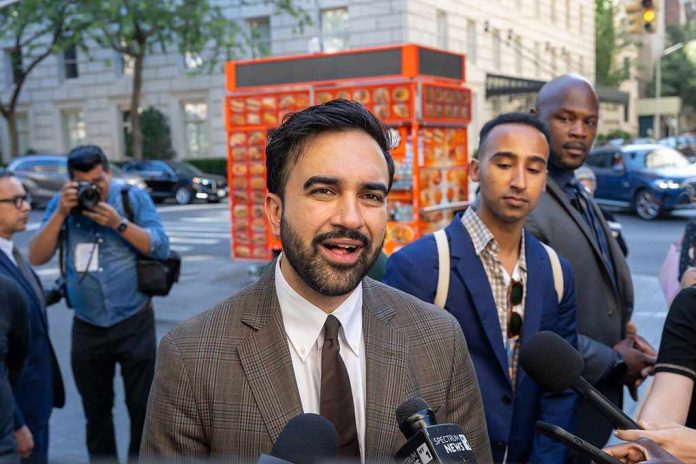
New York City’s mayor used an Oct. 7 remembrance to accuse Israel of “ongoing genocide,” and the blowback was instant and ferocious.
Story Highlights
- Mamdani paired mourning the Oct. 7 victims with charges of genocide and apartheid.
- Israel’s Foreign Ministry blasted him as a “mouthpiece for Hamas propaganda”.
- Jewish outlets said he turned a day of grief into an attack on Israel.
- The full statement also condemned Hamas’ “horrific war crimes” and honored victims.
What Mamdani Said And Why It Lit A Fire
Mayor Zohran Mamdani marked the third anniversary of the Hamas attack by saying the day was “profoundly painful,” mourning the dead, and naming Hamas’ “horrific war crimes.” He then said the suffering “did not begin nor end” on Oct. 7 and accused Israel of an “ongoing genocide” in Gaza, alongside “occupation” and “apartheid.” His office posted the full statement, which closed with a call to honor the dead by fighting for human dignity for all.
That pairing—condolences for Israeli victims followed by sweeping charges against Israel—triggered the clash. Supporters called it moral clarity about Gaza. Critics saw it as hijacking a memorial to batter a U.S. ally. The flashpoint words, “genocide” and “apartheid,” turned the message from comfort into combat in a single paragraph. On a date when leaders usually center grief and condemn antisemitism, the mayor chose a hard political frame that many read as accusatory and out of step.
How Israel And Jewish Groups Responded
Israel’s Foreign Ministry condemned the statement with rare directness. It said Mamdani echoed “Hamas propaganda,” excused terror, and “normalized antisemitism.” That official stamp gave the backlash weight far beyond local politics. Jewish and pro-Israel outlets argued he gave mourners a few lines and then used their grief to demonize Israel, pointing to his use of “genocide,” “apartheid,” and “war crimes” as proof of intent. They framed the post as turning a memorial into an attack.
Some coverage emphasized that this was not a one-off. Reports noted he used similar framing after Oct. 7 in prior years, tying any path to peace to ending “occupation” and dismantling “apartheid.” That pattern helped critics argue this was a predictable move, not a clumsy edit. To them, it signaled a worldview where the focus shifts quickly from Israeli victims to Israel’s faults, especially on the very day many reserve for remembrance.
What The Full Text Does And Does Not Prove
The statement’s first lines clearly mourn the dead and condemn Hamas. That matters. It weakens the claim that he ignored Israeli victims. It also avoids direct attacks on Jews as Jews; the target is Israel’s government and U.S. policy. But the leap to “ongoing genocide” on Oct. 7 made many feel blamed at a funeral. In American conservative terms, that breaks the basic norm of honoring the dead before launching political broadsides—and it strains solidarity with a key democratic ally.
𝐌𝐀𝐌𝐃𝐀𝐍𝐈 𝐒𝐏𝐄𝐍𝐃𝐒 𝐌𝐎𝐒𝐓 𝐎𝐅 𝐇𝐈𝐒 𝐎𝐂𝐓𝐎𝐁𝐄𝐑 𝟕 𝐒𝐓𝐀𝐓𝐄𝐌𝐄𝐍𝐓 𝐀𝐓𝐓𝐀𝐂𝐊𝐈𝐍𝐆 𝐈𝐒𝐑𝐀𝐄𝐋, 𝐍𝐎𝐓 𝐌𝐎𝐔𝐑𝐍𝐈𝐍𝐆 𝐇∗𝐌𝐀𝐒’ 𝐕𝐈𝐂𝐓𝐈𝐌𝐒
Three years to the day since H∗mas stormed the border and m∗rdered more than 1,100 Israelis, New York City… pic.twitter.com/gXvBraFPLr
— M.A. Rothman (@MichaelARothman) October 7, 2026
Whether “genocide” applies is a charged legal question, and most leaders avoid litigating it in remembrance posts. That caution exists for a reason. Words like “genocide” and “apartheid” land not as policy critique but as moral verdicts. On a day of mourning, they read as a judgment against the very people grieving. A prudent leader can condemn Hamas, mourn victims, and press for aid to civilians without reaching for labels that torch trust and unity.
The Larger Pattern And What Comes Next
Other Western leaders marked the anniversary by honoring victims and pledging to fight antisemitism. They tend to separate that message from detailed charges about Gaza, or they save policy fights for other venues. Mamdani stepped outside that script. Newsrooms that reproduced the full text stressed his opening grief and prayers for hostages. Yet the public conversation centered on the one phrase his critics could not miss: “ongoing genocide.” That is the line that will follow him.
The lesson for big-city leaders is simple. Tone is policy on days like Oct. 7. Speak with care, not because debate is banned, but because trust is the fuel for any serious debate that follows. If the goal is to lead all New Yorkers, start by meeting mourners where they are, without caveats. Then, on another day, argue the hard case on Gaza. That order—conscience first, politics later—is not weakness. It is the discipline that holds a plural city together.
Sources:
thegatewaypundit.com, fox5ny.com, wwmt.com, timesofisrael.com, cbsnews.com, politico.com, cnn.com, washingtonexaminer.com